By Horst Severini, University of Oklahoma (OU)
I am again very grateful for STEM-Trek’s support so I could attend SC25 in St. Louis. I met old friends, found new ones, and learned lots of new and exciting information, in both the TANGO/CoNGA workshops and at SC itself.
The GeoFutures Coalition presentation at the TANGO workshop on Friday morning made clear that there is always a trade off between privacy and convenience, such as when we give Google maps our location information in order to get directions. They also emphasized that US Intelligence gathering is only supposed to happen on foreign soil, not in the US — although I’m not convinced that that’s actually what’s happening. The Esri/ArcGIS talk also had lots of good information and reminded me that I went to a Geographic Information Systems (GIS) workshop at the OU Libraries a few years ago, which was also very informative, even though I have to admit that I couldn’t follow the entire tutorial. Lots more information in the T-Kartor presentation, with a good balanced focus on cartography for private use, like orienteering, public maps like finding your way around the London Transport system, and military, like defense mapping, although they were obviously quite vague about the last topic. And the AMD/Dell presentation gave a very nice overview of history and development of CPU and GPU architectures.
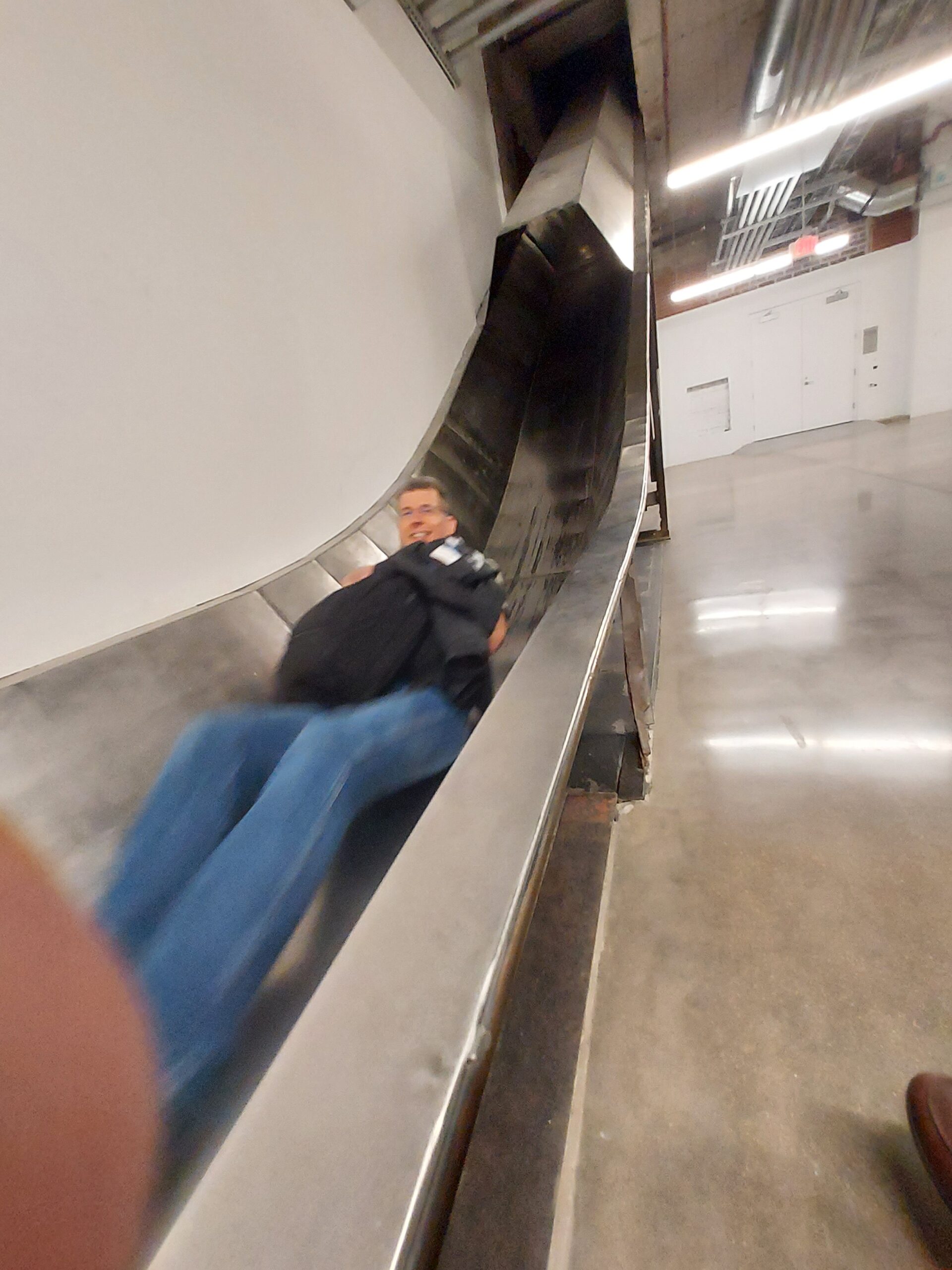
The tour through the former “Post” newspaper building served as a great example successfully re-purposing a vintage industrial space to a modern conference and training facility. We enjoyed the slide that was once a conveyer belt that carried newspapers between floors.
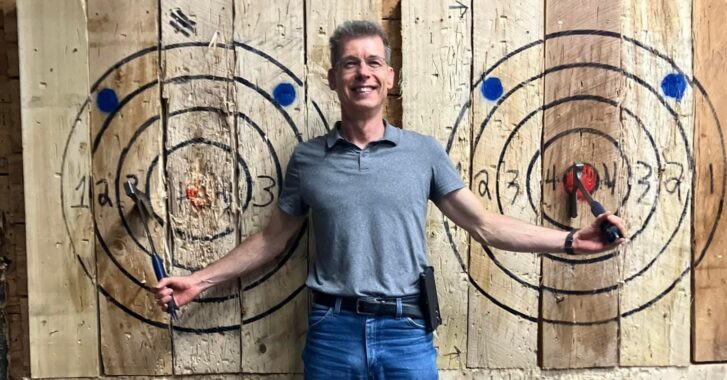
TANGO@SC25’s “Jetlag Day” wound down with a fun activity and pizza party at Top Notch Axe Throwing.
On Saturday morning, the CoNGA workshop gave us lots of interesting information about new hardware and precision calculations (workflows run with greater accuracy and fewer bits thereby addressing both energy and storage issues). It took me a while before I figured out what CoNGA or even NGA (National Geospatial-Intelligence Agency) actually stood for These were spelled out in the agenda, but the first speaker of any workshop should make it a priority to explain all acronyms in their presentation. CoNGA (Conference on Next-Generation Arithmetic) offered great information on the use of numerical algorithms for AI/LLMs. It was quite technical, but still worth listening to, and a very entertaining presentation.
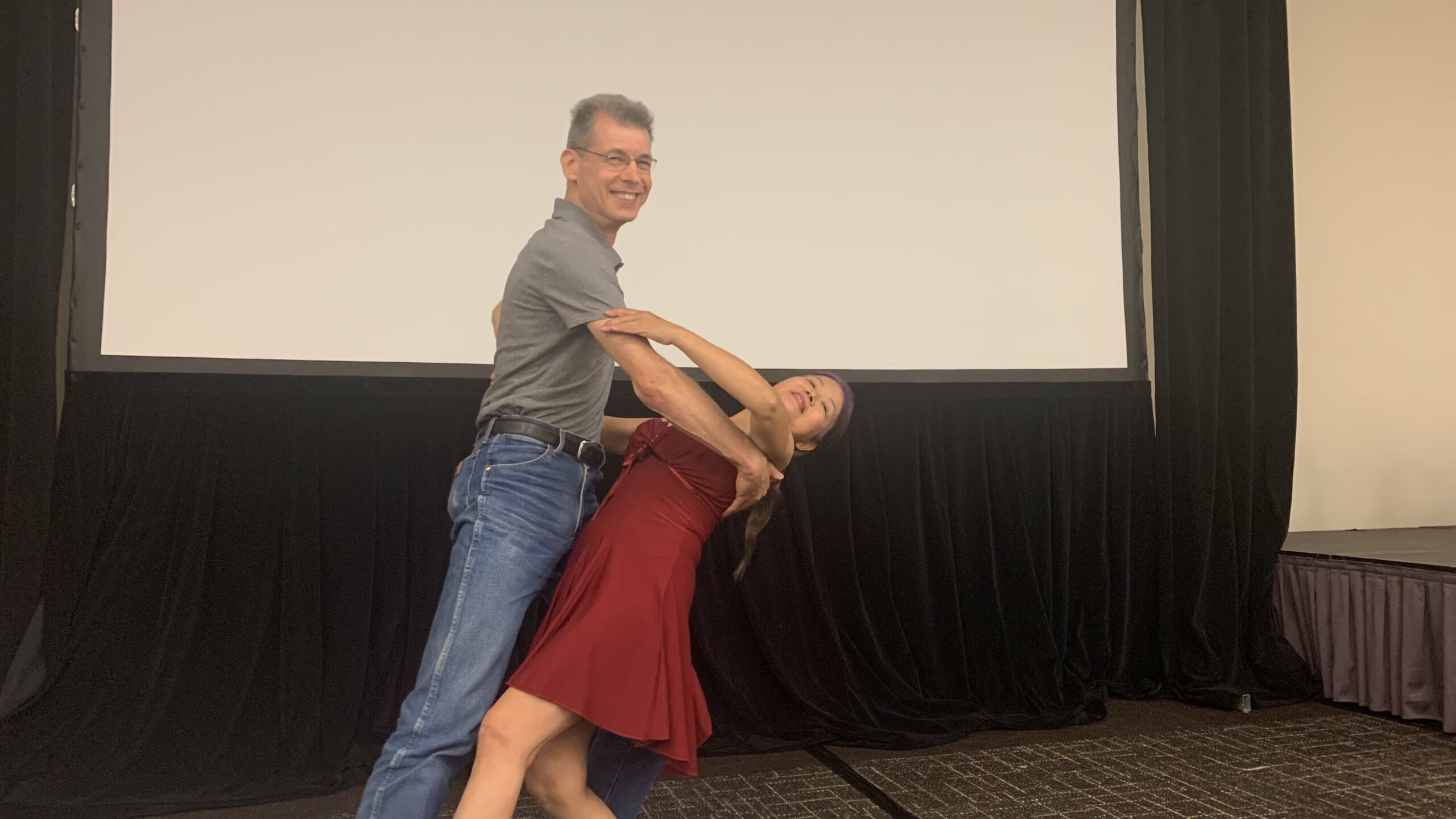
Over lunch, I was very honored to have been asked to do a little Argentine Tango demo with Liwen Shih (U-Houston, Clear Lake), to reflect the TANGO theme. The carpet wasn’t ideal, and Liwen and I had just met the previous day. Despite not having much time to practice, and an obvious height disparity, I think we did okay, and everyone seemed to enjoy it.
The Julia workshop in the afternoon by Wesley Brashear and Jian Tao (Texas A&M) offered a great introduction to Jupyter Notebooks. The code was well documented and easy to follow. The talk about the National Research Platform (NRP) was a good refresher for me, since I had been exposed to NRP before via the Open Science Grid (OSG), One-OCII (the One Oklahoma Cyber Infrastructure Initiative), and from existing HEP (High Energy Physics) collaborations with the University of California at San Diego (UCSD), University of Nebraska-Lincoln, and the Massachusetts Green HPC Center. It also had good details about future applications, and the Information Theory presentation was a thought-provoking presentation about the future of computing, both CPU/GPU architectures, and Next-Gen Arithmetic. It had some fascinating futuristic projections like data centers in space. Again, a very entertaining talk.
The SC25 workshops and tutorials on Sunday and Monday were equally exciting and informative. Some interesting topics in the Digital Twins Workshop were the Evolution from traditional Digital Twin to ‘intelligent’ Digital Twin, which sounded promising. The Human Digital Twin project explores the notion of improving drug effectiveness by scanning patients and simulating the drug propagation through their actual bodies. The Earth-2 Digital Twin is attempting to help mitigate the effects of climate change, which is an extremely critical endeavor these days. Digital Twins at BNL (Brookhaven National Lab) were particularly interesting for me since I worked at BNL as grad student, and I still have many meetings there. The presentations there were not only about high energy physics, but also material and bio sciences.
The Sustainable HPC Workshop discussed among other things that the total power efficiency of computing in the US is only on the order of 30% fuel to usable power output (the other 2/3 just creates heat), which is really not good. Liquid cooling helps, but we need a lot more efficiency improvements down the line. Other countries, like Norway, are MUCH more power efficient by harnessing renewable energies like hydro and wind power for most of their computing and cooling needs. One idea floated for the US was to use pressurized gas pipes to store energy, much like a UPS. Another topic explored was whether it is more economical to keep using older machines longer, compared to keep purchasing new machines every few years. One the one hand, older machines are slower and may use more power than the latest models, but throwing them out is wasteful, and the manufacture of new machines also has a considerable carbon footprint. So, minimizing both power consumption and carbon footprint is a non-trivial optimization problem. There were also several presentations on optimizing power efficiency by scheduling computing loads during times of lower general power usage or the availability of renewable power.
In the Co-Design Workshop, we learned that High Performance Computers should be designed by simultaneous development of hardware, software, and applications, rather than designing a cluster solely based on maximum standard benchmark performance per dollar. Also, there should be a good collaboration between hardware vendors, research labs, and universities. Planning for this is still in very early stages, so it will be a while until we can take full advantage of that.
Another presentation had the somewhat off-topic comment that it is quite easy to poison an LLM. This goes to show that you shouldn’t blindly trust what a ChatBot tells you, since it might be quite wrong, or at least very misleading. Another presenter pointed out that a balanced design is currently not easy, because most funding and emphasis is very skewed towards AI at the moment, whether it’s useful for a particular project or not.
Then I went to an HPC Training and Education workshop: Lots of interesting talks, including a demonstration of UC Merced’s Introductory HPC Training Program, and a good overview/update on NAIRR, the National Artificial Intelligence Research Resource Pilot. They ran several workshops; more then 100 people attended each, and were really interested in learning more about AI, but it will be a long road for them to get there. Also, more discussion about AI-Bots, again stressing that ChatBots can give incorrect answers or answer questions which were not asked because they simply misunderstand the questions. It is somewhat easier to construct a bot that is limited to some specific software documentation, rather than all general knowledge.
Tuesday through Thursday, I walked around the exhibition floor a lot, and attended many meetings and presentations there. In the Campus Champions Meeting, I met fellow campus champions and caught up on what other institutions have been doing. I also got to talk with former colleagues and got very helpful pointers about improving our CephFS cluster file system.
In the GPN Booth, there was a great presentation on HPC on Donated Equipment; it demonstrated how to build a working cluster from donated equipment and make that available to local high schools. There was also a very interesting talk about quantum security. It was a bit over my head, but I still enjoyed listening to it. In the SCiNet Booth, there was a very inspiring talk by Mfundo Mdwadube from our cohort about his path from rural South Africa to his involvement in HPC, and his mentorship of others in similar positions.
The DOE Booth featured a great presentation by Alexei Klimentov from Brookhaven National Laboratory about the REDWOOD project, future plans for Distributed Computing and Data Management, and the monitoring and simulation thereof. This was particularly useful for me since we have an ATLAS Tier2 Computing Center at OU, so we are making extensive use of distributed computing and data management, and therefore these developments will affect us quite a lot. Finally, in the San Diego Supercomputer Center (SDSC) Booth, I attended a really nice presentation/conversation about the value of science with respect to national progress. The presenters pointed out the current disparity between cutting basic science funding vs. wanting to harness the benefits of scientific progress. Meaning, the value of academia is currently disputed by a lot of people, but on the other hand they are expecting to be able to make use of everything that science brings, like AI for example. But without funding for basic sciences, no such progress can be made, obviously.
So, overall, I had another very exciting and successful SC trip, and I hope to attend many more SCs in the future!