By Strahinja Trecakov, New Mexico Consortium
This year I had an opportunity to attend the TANGO@SC2 workshop organized by STEM-Trek in collaboration with Texas A&M University and the Conference on Next-Generation Arithmetic (CoNGA). This workshop took place at the Americas Center Convention Complex in St. Louis, Missouri on Friday and Saturday, November 14-15 before the International Conference on High-Performance Computing (HPC), Networking, Storage and Analysis, SC25. This year’s topic was nonTraditional Architecture and Next-Gen Computational Orchestration where I learned about Compute eXpress Link (CXL), RISC-V and Math that is driving more energy-efficient supercomputers. I was able to attend all CoNGA paper presentations, and keynotes by Jeffrey Sarnoff, Editor in Chief @ IEEE P3109, and John Gustafson, Arizona State University (of Gustafson’s Law). Moreover, during the TANGO workshop, I learned about the National Research Platform (NRP; San Diego Supercomputer Center) and Rogues Gallery testbed (Georgia Tech). This was a great start to a busy week in St. Louis!
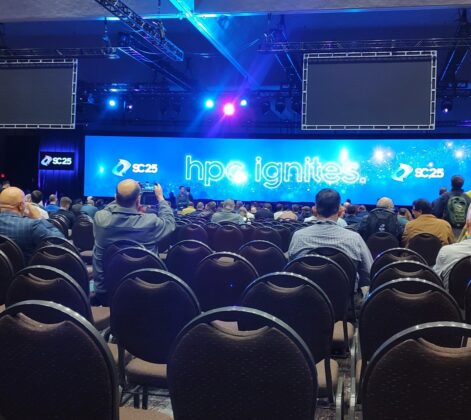
On Sunday, the SC25 conference officially started, and I spent the morning attending the HPC System Professionals Workshop (HPCSYSPROS25) where learned about cool things that other system professionals have worked on in the past year. All the talks were great, and I really enjoyed one by J.D. Maloney who presented an issue and solution for accessing a global Luster file system with multiple authentication domains. In the afternoon, I attended a tutorial on Performance Tuning of HPC and ML/AI Applications with the Roofline Model on GPUs, APUs, and CPUs and few of the paper presentations at the HUST-25.
Monday was a busy day where I attended multiple workshops and tutorials. I began with Delivering HPC: Procurement, Cost Models, Metrics, Value, and More, and then moved around between PMBS25, P3HPC, and ProTools workshops.
The rest of the week, I attended paper presentations, birds of a feather sessions, and panels, and visited many booths in the exhibition hall. I learned about future of some open-source projects at their BoFs: OpenHPC, Slurm, and OpenChami. Moreover, I attended a talk by the Turning Award recipient, Jack Dongarra, who presented a bit of history on Top500 HPC, and where are we today. In between all this, I was able to check out posters that were presented on the 2nd floor and catch up with colleagues from other institutions. The SC conference is great for expanding your knowledge and meeting new people.
This year my scientist-wife, Olivera (an ecologist), was able to attend the conference. This was her first SC experience and the first conference its size. She was amazed with the number of attendees and vendors. Unfortunately, she could not attend any of the technical program, so while I was in training sessions, she explored the exhibition floor talking to companies about what steps they are taking to protect the environment with the drastic increase in power consumption and cooling for supercomputers.
In the evenings we attended social events where we got to relax, and chat with people.
I would like to thank STEM-Trek, Elizabeth Leake and all the sponsors for supporting people from underrepresented institutions and countries to attend the TANGO@SC25 pre-conference workshop and the SC25 conference.